

The snow outside Santa’s workshop looked calm. Inside, nothing was calm at all.
It was late November, one month before Christmas, and Santa had done the unthinkable. He had gone on vacation.
“Just a short break,” he had said, patting everyone on the shoulder. “The workshop runs itself. Pipper will oversee production. Molly will keep the plans on track.”
Pipper heard, you are in charge of everything now, while Molly heard, please do not let anything explode.
Pipper bounced into the main toy floor, eyes shining. “All right, everyone,” she called, “this is our chance to innovate. No more boring deliverables this Christmas. Everything gets upgraded.”
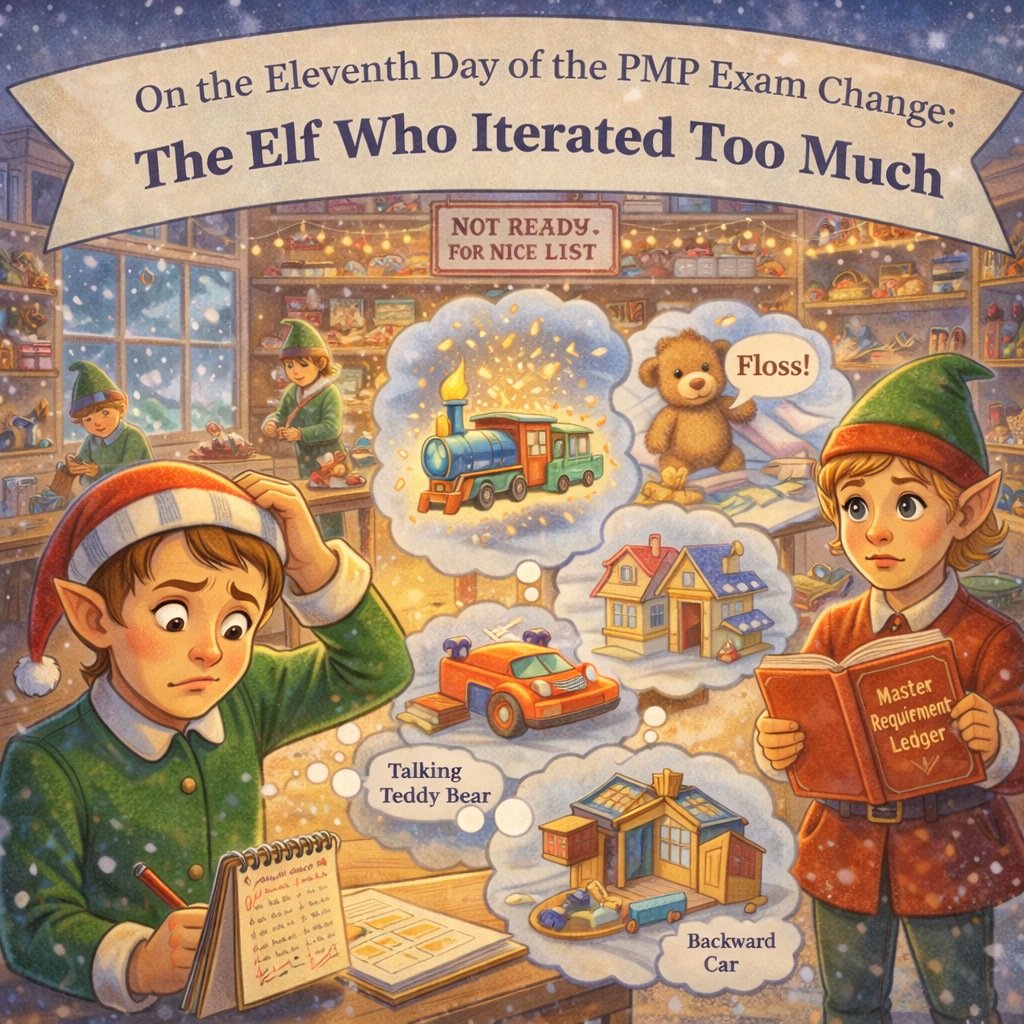
Molly stood at her workbench with the Master Requirements Ledger, also known as the Big Red Book. It’s what parents actually ask for. Her peppermint tea steamed gently beside a stack of schedule charts.
“Pipper,” Molly said, “the deliverables are already defined. We build them, inspect them, and ship them.”
Pipper waved that away. “Deliverables evolve, Molly. We must embrace iteration.”
Molly narrowed her eyes. “Iteration with inspection. And value tracking. Not random chaos in glitter form.”
Pipper grinned. “Unnecessary details. Let us start with the trains.”
They walked to the train line. Rows of simple wooden trains waited for wheels and paint.
“The spec,” Molly said, tapping the ledger, “is a classic wooden train. Red engine. Blue cars. No special effects. Parents requested durable, quiet, and not likely to wake them up at three in the morning.”
Pipper leaned in. “Nonsense! Hover trains that shoot celebratory glitter.”
“That is not in the requirements.”
“Innovation, Molly. Innovation.”.
By lunch, the first train hovered three inches off the bench, humming softly and firing glitter whenever someone walked past. Three elves were already sneezing.
Molly wrote, “Inspection result: fails acceptance criteria. Causes allergic glitter storm.”
Pipper shrugged. “We can fix that in the next iteration.”
She added “Silent hover mode” and “Allergy friendly glitter” to her own notebook.
They moved on to the teddy bear line.
“The bear spec,” Molly read, “is soft, huggable, does not talk.”
“New requirement, Pipper said. “The bear reminds children to brush their teeth. This is added value.”
“From whom,” Molly asked.
“From me. I’m an internal stakeholder.”
By afternoon, the first prototype bear sat blinking on the table. An elf patted its head.
“Remember to floss,” the bear said cheerfully. “And check under your bed for bedtime monsters.”
Molly wrote, “Inspection result: fails expectations. Causes bedtime trauma.”
Pipper winced. “We can soften that in version two.”
On the far bench, misfit prototypes gathered: the glitter-hover train, the motivational bear, a dollhouse that rearranged its own furniture, and a race car that insisted on driving backward on square wheels.
Molly labeled the shelf, “Evolving Deliverables,” then added, “Not Ready for the Nice List.”
The next morning she called a stand up.
“All right,” she said, “we need structure. Deliverables can change, but not at random. We confirm requirements, build to agreement, inspect, and adjust only when changes actually add value. No more surprise updates.”
Pipper raised a hand. “What if I get a brilliant idea?”
“Then you log it. It goes into backlog refinement. We look at it at the next iteration checkpoint.”
Pipper groaned. “That sounds slow.”
“It is faster than rebuilding the entire workshop every day,” Molly said quietly. “Wanting better is good, Pipper. Doing everything at once is not.”
Pipper glanced at the misfit shelf. The hover train sneezed glitter. The motivational bear lectured the dollhouse. It was a lot.
“All right,” Pipper said softly. “Let us try it your way.”
They started with the train again.
“Stakeholder intent,” Molly said, “is quiet, sturdy joy. If we want to iterate, what small change increases value without surprising parents or terrifying pets?”
Pipper thought. “A tiny soft light in the engine so it glows gently in the dark. No sound. No glitter.”
“That aligns with the original vision,” Molly said. “We document it, update the spec, build one, and test.”
Lights dimmed. The train glowed softly and chugged along the track without hovering or exploding.
Molly checked the box. “That adds value.”
Then came the bear.
Pipper eyed the motivational prototype. “Fine. No flossing lectures. What if the bear plays a lullaby? Calm. Gentle.”
“Stakeholder intent was comfort,” Molly said. “A lullaby fits.”
They built Version Two. The bear blinked once and released a soft, soothing tune. Not the blaring test version that had sent three elves running and a reindeer through a snow fence.
“That is the right kind of magic,” Molly whispered.
They created the Value Tracking Wall. Under each toy, Molly wrote the original intent, inspected changes, and whether they increased real value or just noise.
By week’s end, the misfit shelf had shrunk. Some toys were simplified. Others upgraded in small, thoughtful ways grounded in actual needs, not spontaneous inspiration.
Two days later, Santa returned early from vacation.
He walked through the workshop quietly, hands behind his back, eyes taking in the glowing trains, the lullaby bears, the neat boards, and a significantly smaller misfit shelf.
He stopped beside the Value Tracking Wall. “What is this?”
Molly swallowed. “Inspection notes. Backlog decisions. Evidence our deliverables evolved for the better instead of spinning out of control.”
Pipper stepped beside her. “I tried to improve everything at once. Molly showed me how to let things change without losing purpose.”
Santa studied the board, then smiled. “Looks like you learned the most important part. Christmas changes every year. Children grow and needs shift. The magic stays because we guide the change instead of ignoring it.”
Pipper glanced at the misfit shelf. “What about those?”
Santa chuckled. “Oh, store them. Label them. Some of next year’s best ideas start as this year’s misfit deliverables.”